Context and Audience
I designed two scenario-based eLearning interactions in Rise 360 to help K–5 teachers practice standards alignment (LO2) and plan feasible 5-day Project-Based Learning (PBL) projects (LO3). Each scenario uses a different interaction type selected to mirror how teachers actually make planning decisions.
Live Preview
5.1 Scenario-Based eLearning_Blanke
Scenario 1: Standards-to-Objectives Alignment (LO2)
Interaction Type: Problem-Solving with decision checks
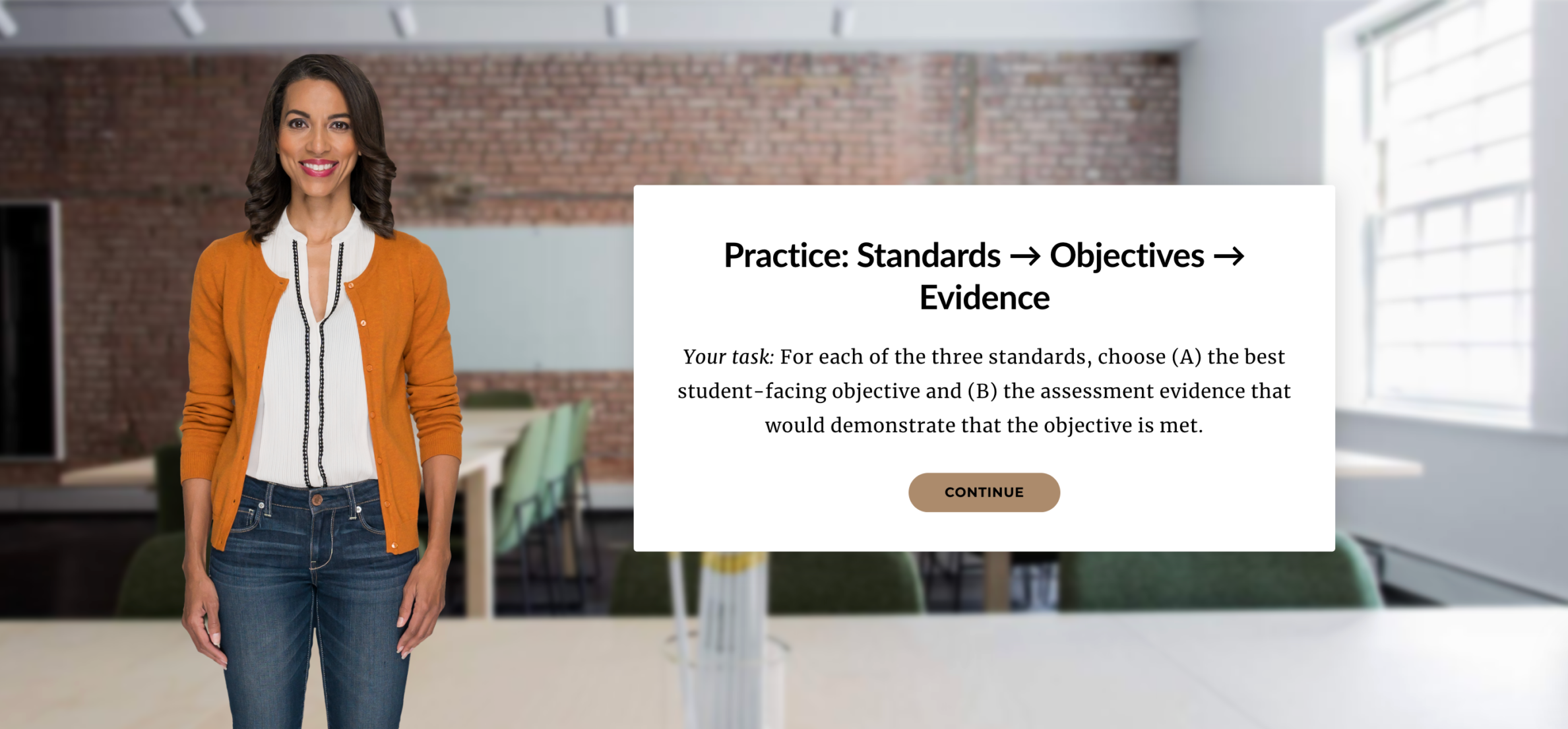
This scenario gives teachers realistic classroom cases and asks them to choose appropriate standards, write a single-verb objective, and select matching evidence. I used a Problem-Solving approach because standards alignment is inherently analytical. Teachers must interpret context, evaluate options, and apply rules. The embedded decision checks keep the interaction focused and job-relevant without requiring a full branching build.
Scenario 2: Designing a 5-Day Project Prototype (LO3)
Interaction Type: Decision-Point → Guided Authoring
In this scenario, teachers help “Elena,” a 4th-grade teacher, refine an overly craft-heavy project idea into a rigorous learning experience. Teachers walk through decisions about reframing the task, selecting standards, and tightening rubric criteria. The Decision-Point approach fits because project design requires evaluating tradeoffs: fun ideas vs. measurable outcomes.
Tools Used
Rise 360, Google Docs (PD_Project_Plan_Template), Google Drive (resource storage)